

Ismail Haj Bakri
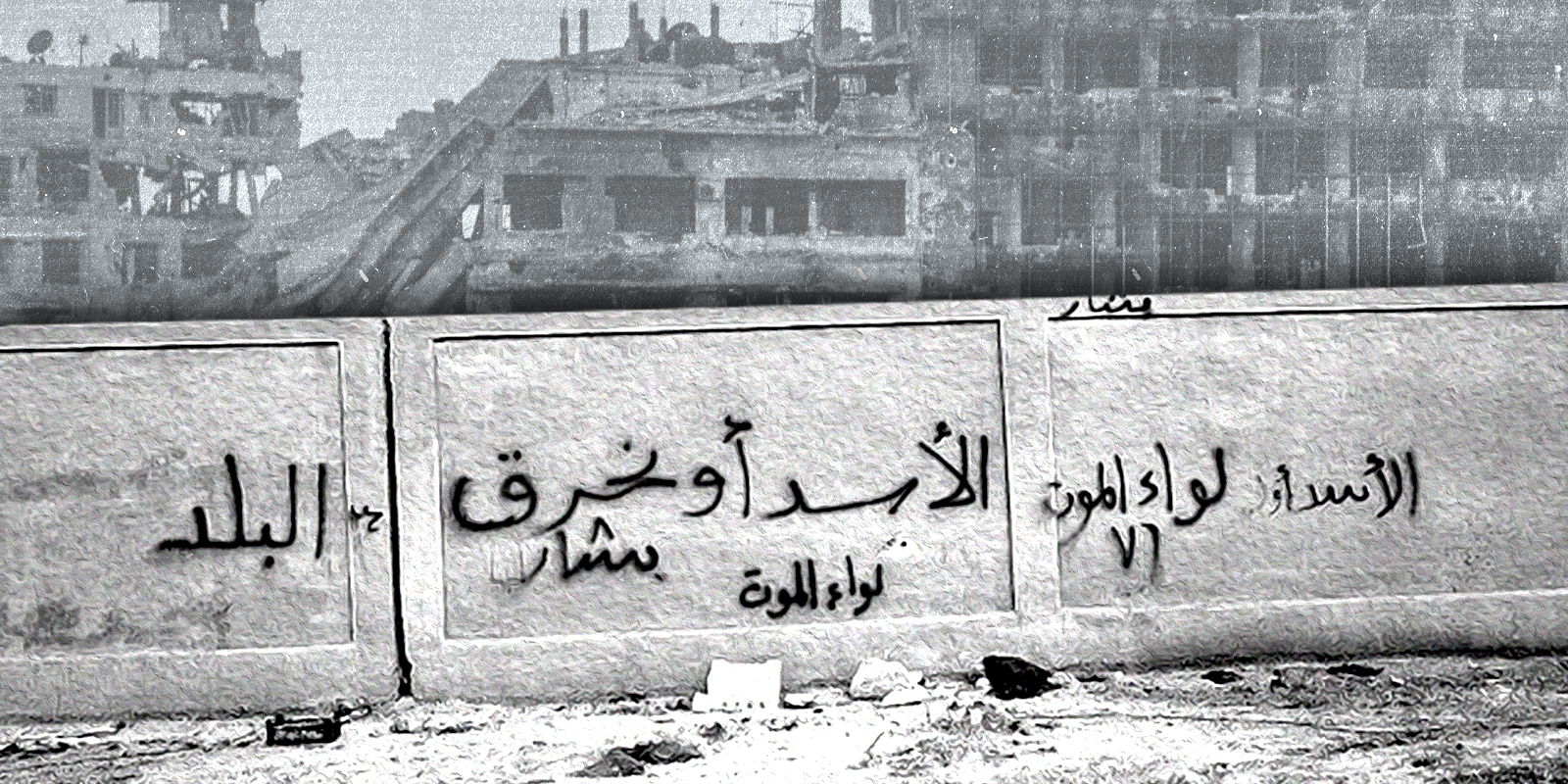
The slogan “Assad or We Burn the Country” was not merely a phrase that emerged during a moment of political violence. Rather, it was the most concise expression of a governing logic that had taken shape over decades—a logic that tied the survival of the state to the survival of the regime, stability to loyalty, and politics to fear. Within this framework, Syria was not governed as a public sphere for equal citizens, but as a space of continuous control, constantly reshaped whenever the interests of those in power required it.
Since the Ba’ath Party came to power in 1963, the question of the state in Syria was never presented as a national project, but rather as an instrument of control. Society was not viewed as a partner in producing legitimacy, but as a silent and homogeneous community whose loyalty was directed toward the leader and the ruling party. Citizenship was stripped of its substantive meaning and redefined as a privilege granted by the authorities. Within this equation, the state was built not on trust but on fear, producing not citizens but cautious individuals who understood the limits imposed upon them. Over time, influence and privileges were distributed according to proximity to power and informal affiliation with its networks.
When the Syrian uprising began in 2011, it did not create division within Syrian society; it revealed it. What surfaced was not a consequence of the revolution itself, but the result of years of political and social repression. As the authority of the central state weakened, the vacuum concealed by decades of security control became visible. In the absence of inclusive institutions, many Syrians turned to religious, regional, and tribal identities—not as alternative political projects, but as mechanisms of protection in the face of uncertainty. The problem was not the emergence of these identities in itself, but the absence of a comprehensive political project capable of managing them. Amid the limited role of cultural and intellectual elites, these affiliations became instruments that were exploited by local and regional actors, deepening Syria’s social and political fractures.
One of the most significant realities exposed by the Syrian conflict was the myth of the “homogeneous society” that the regime had promoted for decades. Such a society never truly existed; it was imposed through coercion. Once that coercive power weakened, the façade quickly collapsed. What remained was a diverse society lacking a social contract and institutions capable of managing difference. A state that relies on security control rather than legitimacy may postpone an explosion, but it cannot prevent it. When such a state falters, the resulting vacuum allows competing identities to struggle over what remains of authority.
The social contract in Syria was never built as an agreement between society and the state. Instead, it was imposed from above and was therefore inherently fragile. The relationship between ruler and ruled was not defined through mutual rights and responsibilities, but through obedience in exchange for protection. When this equation collapsed, society found itself without a unifying reference point. In this context, civil peace was often presented as a simple solution. Yet genuine social peace cannot be achieved through top-down decisions or symbolic committees. It is a long political and social process that begins with mutual recognition of suffering and requires a comprehensive national dialogue that includes all Syrian communities, especially those that experienced the greatest marginalization and harm throughout the conflict.